A few days ago I gave a talk at the AI Enhanced Mathematician webinar (Sept 5th, 2026) on something I’ve been chewing on for a while: why students forget almost everything we teach them within days, and what we can actually build — not just tell them — to fix that. This post is a write-up of that talk. If you’d rather watch it, here’s the recording.
The 1% philosophy
I like to open with the story of British Cycling’s “marginal gains” turnaround. The idea was simple: break down everything that goes into riding a bike, improve each piece by just 1%, and the sum of all those tiny improvements compounds into something significant. Better tyres, seats, frames, helmets, race suits, personalized training, even the paint on the inside of the team truck and the soap riders washed their hands with — none of these individually win a race. Together, they did.
This talk is my attempt at a 1% improvement on one very specific, very important part of teaching: helping students actually remember what we teach them.
The retention problem
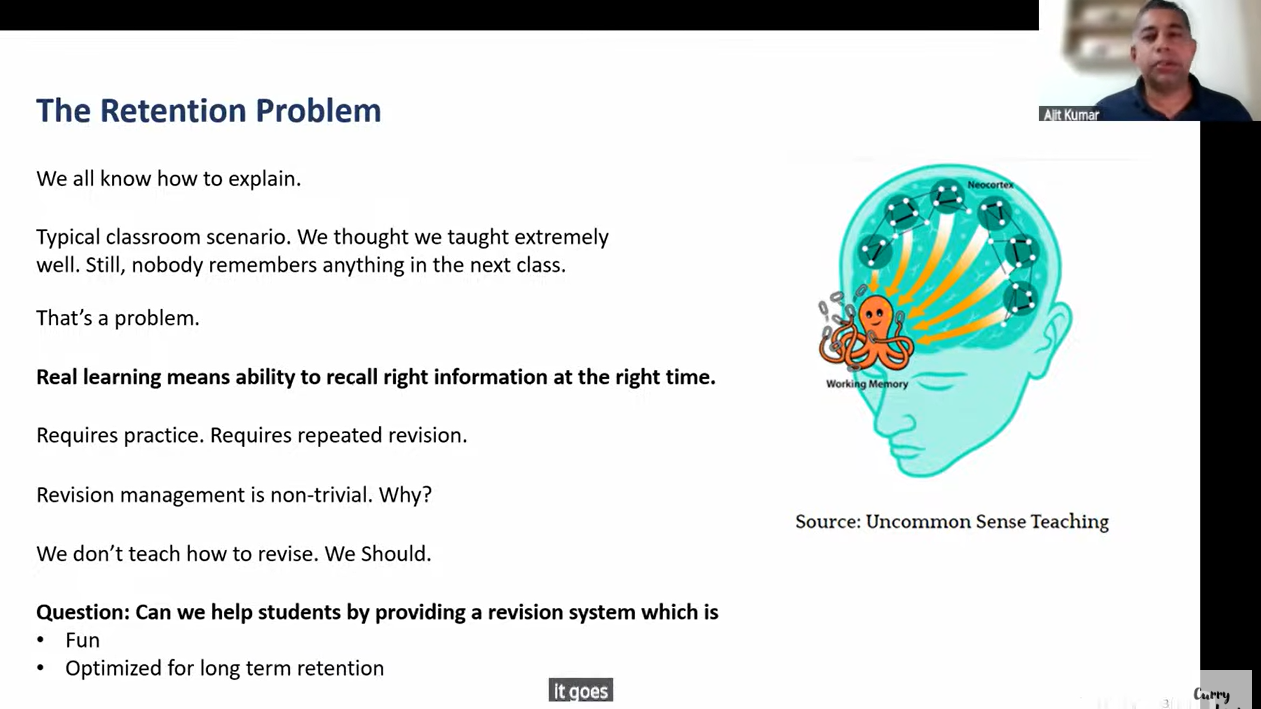
Every teacher has lived this scene: you explain a concept thoroughly, the class nods along, everyone seems to get it — and by the next lecture, nobody remembers a thing.
That’s because knowing something in the moment and being able to recall it later are completely different skills. Real learning is the ability to retrieve the right information at the right time, and that ability requires practice — specifically, repeated revision. The problem is that revision itself is hard to manage: students don’t know how to revise, and, frankly, we don’t teach them how. We tell them what to study, almost never how to study it.
So the question I set out to answer was: can we give students a revision system that is both fun and genuinely optimized for long-term retention?
Two ingredients: Active Recall and Spaced Repetition
There’s decades of cognitive science behind the answer, and it boils down to two techniques.
Active Recall is revising by retrieving, not re-reading. Compare a passive statement — “India’s capital is New Delhi” — with an active version: “What is India’s capital?” followed by the retrieval effort of answering it yourself. The second version is dramatically more effective for retention, because the act of retrieving is what strengthens the memory. In practice, this means encouraging students to turn their notes into flashcards.
Spaced Repetition governs when you revise, not just how. Instead of cramming, you revisit material at deliberately growing intervals — first read on Day 0, revise on Day 1, again on Day 4, again on Day 9, and so on. The gaps get longer each time. This spacing effect is one of the most robust, most replicated findings in memory research, and it consistently beats cramming for long-term retention.
The problem with “just tell students to do it”
Active recall and spaced repetition are both simple to explain and hard to get students to actually adopt on their own. A few honest questions I had to confront:
- Will students actually make flashcards themselves?
- Will they spontaneously start spacing out their revisions?
- How do you build spaced repetition into a student’s existing study habits?
- And, as an instructor, how would I even know whether my students are following any of this?
Good pedagogy that nobody adopts doesn’t help anyone. So the next step wasn’t more advice — it was tooling.
What we built
We set up a self-hosted Moodle server — the open-source alternative to Blackboard. It’s fully customizable, though that customizability comes at the cost of having to manage the server ourselves.
To remove the “will students make flashcards” problem entirely, we flipped the responsibility: instead of asking students to author flashcards, we use Claude AI to convert textbook content directly into a series of flashcards. Students don’t create anything — they just log in and review flashcards the instructor has already prepared. (The tooling behind this is open on GitHub: moodle-bulk-page-creater.)
On top of that, we customized Moodle to support spaced repetition natively, letting it:
- Record a student’s self-assessed mastery level for each flashcard
- Track how many times a flashcard has been studied
- Set and remind students of the next revision date for each card
We also added a class-participation view, so revision activity isn’t a black box to the instructor anymore.
Where the science comes in
The more recent, ongoing part of this work — done in collaboration with Aristotle University of Thessaloniki and Overpass Connect — takes this from “a flashcard app” to something closer to a proper learning-science instrument. A few pieces worth highlighting:
Forgetting is measurable. After you study something, your probability of recalling it decays along a well-studied curve. We build on an established, open, peer-reviewed memory model (the FSRS family) rather than inventing our own black box, so the underlying science stays inspectable. Because the curve is explicit, the system can compute — for any learner, any flashcard — when a memory is likely to fade and how much a given review will strengthen it. Scheduling stops being guesswork and becomes a calculation.
Mastery should mean durability, not a snapshot. If you measure “mastery” right after a student reviews a card, everyone looks like a genius — that’s just rewarding cramming. Instead, we project the recall curve forward to a chosen horizon (say, the exam date) and ask: will this student still remember this a month from now? That horizon is a dial instructors can set to match their actual course calendar, without changing how the course itself is taught or graded.
Revision data doubles as teaching evidence. This might be my favorite part. The same flashcard activity that helps a student revise also, as a side effect, tells us something objective about the course itself — which topics students are actually finding hard. We infer “experienced difficulty” purely from graded recall performance (how often something is failed, forgotten, or answered slowly), no answer key needed, and blend several such signals into one comparable difficulty score per topic.
Put together, this becomes a loop with two audiences: students revise → that generates authentic learning data → which becomes benchmarking evidence → which faculty act on to teach better → which improves outcomes → which feeds back into the loop. The two sides reinforce each other — student benefit generates the data, and the data improves the teaching that benefits the next round of students.
Where this leaves us
Learning ultimately comes down to being able to recall the right information at the right time, and that requires structured revision and practice — not willpower. What we’ve built is a tool that doesn’t just suggest good revision habits, it measures and tracks them, and turns that measurement into something faculty can act on.
We’re currently extending this by structuring an entire syllabus as a network of chapters, readings, and example problems, and studying how revision patterns map onto real subject mastery over a term.
If you want to dig into the details, watch the full talk here: Helping Students Remember Course Content for Longer.
Ajit Kumar, Assistant Professor, Mathematics, Shiv Nadar University (SNU) — ajit.kumar@snu.edu.in · Moodle instance: 47.131.190.59 · GitHub: github.com/krajit